Showing posts with label Neil Gaiman. Show all posts

Monday, October 11, 2010

Cannonball Read #35: Good Omens by Neil Gaiman and Terry Pratchett


(I've decided to create a "Neil Gaiman" tag for my posts since I've read so much of his work.)

I read "Good Omens" close to about a month ago, and the details are a little hazy in my brain. I am, however, really glad that I actually bought the book, because I can go back and reread it. This book was so much fun to read, and parts of it had me guffawing on my morning subway ride to work. "Good Omens" is definitely my favorite Gaiman so far, and the fact that it is a collaboration with Terry Pratchett is not lost on me.

The story is about an on-coming apocalypse brought upon by the Anti-Christ, who was raised as a human boy on Earth by human parents, and an angel and demon's race to stop it. No, not really - it's more than that.

It's also about the prophecies of a crazy-accurate witch, Agnes, from the 1655 and her descendant, Anathema, trying to interpret the crazy babble about the circumstances of the apocalypse. She meets the descendant to the witch-hunter who killed Agnes, and (as it is already written in Agnes' prophecies) starts developing fuzzy feelings for him. But it's not just that.

It's about the friendship between an angel and a demon who actually both quite like the world they live in, and do not wish for it to be destroyed. So they start giving the young Anti-Christ a balanced education of both good and evil, so that he will be persuaded to not destroy the Earth. Too bad they got the wrong boy - he's as normal as can be, except for the fact that he can probably now recite some really strange nursery rhymes. Aziraphale and Crowley's friendship was some of my favorite parts of the book. They were sarcastic and acerbic and wonderfully real to each other.

It's about a young boy named Adam who loves the town he has grown up in and loves his friends, family and life - that when given the chance to taste enormous power, he decides to do the very grown-up thing of just sitting back and letting his parents ground him.

Finally, it's about never being able to plan something as specific as life and death, especially if it's for the decimation of an entire world. Something/demon/angel/child is always going to come along and fuck up the plans for boom-boom wars.

As you can see, it is very difficult for me to write a coherent synopsis of this book (and not just because I waited a month to write it). It's mostly hilarious and partly sad, and there are also some very interesting ideas about fate here that would probably only give me a headache if I think too hard about it. This is definitely one to reread, if only just to see if I caught all the jokes and details.

Monday, June 21, 2010

Cannonball Read #26: Anansi Boys by Neil Gaiman


I know that Anansi Boys is somewhat connected to American Gods in terms of mythology, but I think that's about where the similarities end. Though there are some familiar faces, I was still able to come to this with a clean slate of mind.

Fat Charlie Nancy has spent most of his adult life avoiding his father because he is constantly embarrassed by him. But when his father passes away abruptly, Fat Charlie has to return home for the funeral. There, he finds out from an old family friend that his father was Anansi, the spider-god or a god of mischief, and that he has a brother, Spider. Spider is charismatic and lucky and handsome; but he is also trouble. Fat Charlie invites Spider into his life, but then promptly wishes him out. However, Spider cannot seem to take no for an answer – he has probably never had anyone refuse him anything. So Fat Charlie decides to appeal to the other gods, gods who hated his father for his history of trickery, to help make his brother go away. Personally, I did not think Fat Charlie seem particularly smart.

That's basically the first third of the book. One of my favorite things about reading Gaiman is that I never know the twists he's going to take, and then he surprises me even more when he makes it all fit organically into a she-bang ending. All the threads of an event go off in multiple directions, yet they somehow end up in a climatic finale that does not feel forced. Anansi Boys – and now that I think about it, American Gods did this too – really makes me wonder how large a role Gaiman wants fate to play in his stories. In American Gods, it was implied at the end that the Gods had planned for the whole entire thing to go down (I'm being vague on purpose here). But in Anansi Boys, it's not quite so clear whether if Anansi had any idea about the shenanigans his sons would get into after his death. I liked that the gods were not quite so all-powerful this time around, and that there were other minor players that actually propelled the story forward.

Anyway, I really shouldn't compare this to American Gods since it's so different. One thing that I've really started to appreciate about Gaiman is that he really lets his readers draw their own inferences. He doesn't try to emotionally manipulate us - which is nice. However, the downside of it is that Gaiman's writing can seem a little bit cold at times. I sincerely think he's good, and I have a great time reading his books (I've read more Gaiman during the Cannonball Read than any other authors.) But I can't seem to muster up as much passion for it as when I think about any of Steinbeck's books – who incidentally, does occasionally try to manipulate his readers, so I guess that tells you how much I know what I want or like to read.

Monday, April 12, 2010

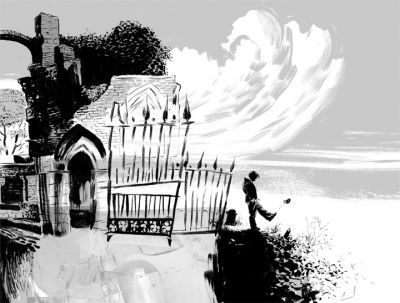
Cannonball Read #21 and #22: The Graveyard Book by Neil Gaiman; The Jungle Book by Rudyard Kipling


Oh Pajiba, how I love thee. Just for you, I bought a hard-cover book so that I could read it for the Book Club discussion. It usually takes me ages to actually put down cold, hard cash for a book, especially for one whose spine is stiffer than my own.

Lucky for me, The Graveyard Book was an awesome read. I literally devoured the pages (and yes, I used "literally" correctly because I was coughing up paper for days after) (ha ha, lame joke, just kidding - just wanted to annoy you grammar freaks) and finished it in a night, and after I was done, I was so sad. I wanted to know more about Bod's guardian, Silas, and I wanted to know how Bod got on in the normal world.

Nobody Owens, Bod for short, was raised in a graveyard by its ghostly residents. When he was a baby, he crawled into the graveyard in the night, pursued by a man who had just murdered the baby's family. The Owens, who have been dead for a long time, took him in as their own, and appointed Silas as his guardian. Silas is someone who belongs neither to the human world and the ghost world and is seen as very knowledgeable.

The entire book is basically about Bod's very special childhood, what he learns, and what he can do. I really liked the progression of how he went from being a child who asked a lot of questions to a teenager who was willing to stand up for himself and accept his differences as a part of himself.

Anyway, since this book is modeled after The Jungle Book by Rudyard Kipling, I picked it up next. I don't remember the Disney cartoon, so this was pretty much a fresh impression for me. I think I made the mistake of trying to see the similarities because even though the general structure is the same, the story is quite different.


Mowgli is adopted by a pack of wolves in the jungle. His family of wolves refuse to give him up to the lame tiger who hunts him. The tiger had to give up Mowgli when the wolves took him in because he knew that he would not be able to defend himself against a united pack.

I thought it was interesting that Kipling gave the jungle a set of rules that all the respectable animals felt they had to follow. For example, most of the animals don't believe in eating humans because they are the weakest creatures and cannot defend themselves. The wolves also scorn the lame tiger because he attacks cattle and they are slow and not much of a challenge. Monkeys are often ignored because they do not have a code to follow and therefore are not considered worthy of attention.

Mowgli's story was only for half the book. There was also stories of other animals, like a snow white seal that roamed the oceans for a perfect spot to raise a family, a shore that no humans have ever touched. I also enjoyed the story of the mongoose that defends a human family from the cobras living in their backyard.

I do sincerely wish that I had read The Jungle Book when I was younger though. It's a very straightforward book, in terms of the character development and plot. There are also rhyme verses at the end of every chapter, so I can see myself enjoying that immensely as a kid – whereas now, I would want to rush through those. I'm glad I have read it, though (and I know it's almost criminal to say this) I think I enjoyed The Graveyard Book more. I liked how dark it was, and also how Gaiman once again touched upon his oft-used theme of personal growth and acceptance in the character of Bod.

Monday, February 1, 2010

Cannonball Read #14: American Gods by Neil Gaiman


Blakspring and Jen K. recommended American Gods to me in my quest for more Gaiman. After reading it, I realized that this book has been reviewed many times by Cannonballers (Pajiba has even previously published a review of it) so I'm not sure if there is much more I can add to it.

The basic premise is that the gods of the old world and the gods of the new world are about to wage a battle, and one man, Shadow, is in for the ride of it. Shadow, a recently convicted gentle giant (I kept thinking that as I read on), was released a couple days early from jail because his wife was killed in a car accident. He is promptly hired by the mysterious Wednesday, who is later revealed to be the Norse god Odin, the All-Father, to just basically be an errand boy. Wednesday is trying to convince all the other old-world gods to join their forces and go to war with the gods of the new world, like the god of Media, or the god of the Internet.

Reading this felt a little like swimming underwater without goggles. I never knew which direction it was going - I was confused whether if this was reality or fantasy, and once I realized it was both, I was confused about the Bigger Picture. There was not much exposition or explanation. I definitely had to read behind the lines of the actual story in order to really understand it, and even then, I'm not sure if I quite get it. It was the story of Shadow that really kept me going. In addition, Gaiman's writing is fantastic. My favorite parts of the book (besides just following Shadow's adventures) were the little sections tucked in between the main story of how the gods are currently living in America.

After reading three books by him (Coraline, Stardust, and this), I still cannot see much similarities in writing except that it is phenomenal. If I had to quibble about this book, I would say that a lot of the events are a little too dream-like and whimsical for me. Hopefully, I will be able to understand it better/get more out of it when I re-read it.

Tuesday, December 1, 2009

Cannonball Read #5: Stardust by Neil Gaiman


Stardust is the first book I bought for my Kindle because I just couldn't wait for my local library to have it freed up. I've been in such a Stardust-y mood ever since I re-watched the movie with Jana, and I just needed it in my hands right away because I am such a fan of everything in that movie. So it was a little disappointing, in the beginning, when I realized that the movie did not adhere very closely to the book. ("The book doesn't follow the movie!" I thought irrationally.)

But a couple chapters into the book, it totally clicked for me. I started seeing the book (reading the book?) for itself and stopped comparing it to the merits of the movie. When I describe the plot, it will sound a lot like the movie, but it's the details in the book (and they absolutely matter) that are really different. Unlike the movie, Gaiman spends a lot more time setting up the context and describing the people living in the town of Wall. Wall borders the magic world and it is separated by a wall and some very insistent guards. We learn about Dunstan Thorn, who wishes to seek his Heart's Desire, which apparently is... either getting laid by a hot girl who is across the Wall; or a son. Because in 9 months, a son is delivered to him across the Wall named Tristran (which is really difficult to say out loud.)

Though Tristran seems like a young boy who is painfully aware of his ordinariness, he still exhibit signs of boldness. When his true love, Victoria, told him that she would do anything for him if he were to fetch a shooting star for her, he immediately agrees and sets off across the Wall in search of the star. The star, as it turns out, is a person – a girl named Yvaine. Tristran goes through a series of crazy adventures to get to her, and then goes through another series of adventures to get her back to his town. Meanwhile, they have an old witch who is hot on the heels of the star because eating the heart of a star promises immortality.

The ending is really different than the movie, and it really highlights how subtle all the characters are, even the evil ones like the Princes fighting for the crown or the crazy witch. We don't need loud proclamations of love to know that a person's in love; sometimes evil witches can still be evil after they choose a different route (no crazy voodoo is needed); and sometimes a hero does not need to be a swashbuckling sword-wielder to prove that he has grown up. Gaiman managed to show the growth of his characters through their very subtle actions - not by some grand, dramatic gesture – and I really appreciated that because that's kinda like how real life works.

I wrote in my Coraline review that Neil Gaiman used a minimal amount of language to convey something with maximum impact, and I wondered if that was something that is prevalent in his books. In Stardust, there is a very different writing style. He is more descriptive, yet there is so much poetry in his writing. I loved how he used certain words and phrases, and highlighted them in my Kindle:

"The evening sky hangs above us, the color of a bruise, and clouds carpet the world beneath us, all grey and writhing."


"So," said a voice from behind him, soft as a silken strangling-rope, sweet as a poisoned lozenge, "you thought that you would warm yourself at the burning of my cottage?..."


If I wrote like that, it would just come off as pretentious. I really need to buy this in book form so that I can hold it in my hands. This is a book I want to flip back to certain pages to reread passages, or to remind myself of a favorite moment. It was so good that I stopped seeing Yvaine as Claire Danes or the witch as Michelle Pheiffer. That's not to say that I like the movie any less now. I just like both the book and movie for very different reasons.

Monday, November 16, 2009

Cannonball Read #3: Coraline by Neil Gaiman


Coraline was my first Neil Gaiman book ever (Thanks for recommending it, Rebecca!) and it was not like I imagined. I didn't watch the movie, just the trailer, so I wasn't spoilered by much. My synopsis is gonna basically be like how the preview set up: Coraline is very bored with the world she lives in. Her parents seem like regular parents; her neighbors like old farts; and there aren't interesting places to explore around her house. One day, she discovers a little door in the drawing room (I'm gonna assume that's like British for home office or something) that leads to a different parallel world. It's similar to her old life, yet there are some peculiar modifications. The most disconcerting difference (to Coraline) is that all the people in this world had dark, shiny buttons for eyes instead of... well, eyes.

I'm not sure what else to say about the plot because I don't want to give everything away and it was quite short (My copy is 162 pages with big-ish print.) What stood out to me about Coraline was how mature she was about her seriously bizarre situation. I don't remember how old she's supposed to be (was it mentioned in the book?) but I assumed around 10, and there was a part where she went on a speech (it was long, considering how short most of the dialogue/descriptions were) that basically boiled down to her realization that being brave does not exclude being scared. In fact, doing something even though you are scared is what makes the action brave. That little speech was really my favorite part of the book.

As I said before, I've never read anything by Gaiman so this was really an en eye-opener. I don't know what I was expecting but I was really surprised by how sparse, yet detailed, his language is. His diction and sentence structure was really carefully chosen because he conveyed a lot without writing a great amount. It's strange because I consider reading fiction to be something I have to slough through – it's a enjoyable slough though. And I admire people who can write long detailed descriptions that make me want to read them, not skim through it. But even more than that, I aspire to write concisely about things that aren't necessarily full of facts (comes with my journalism degree/dreams.) So Gaiman's style was just such a pleasure to read. I look forward to checking out other stuff from him.